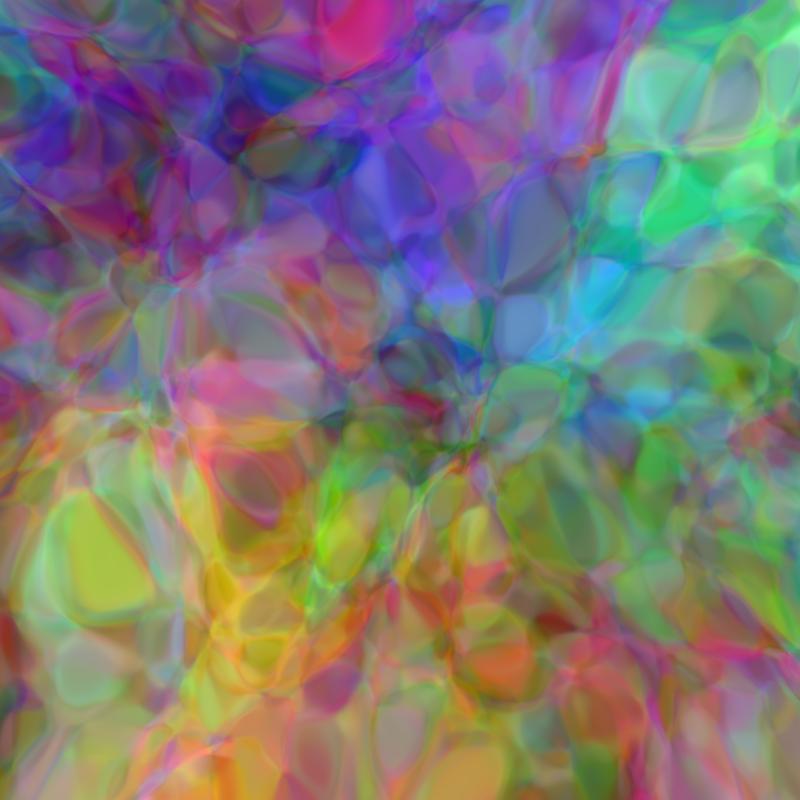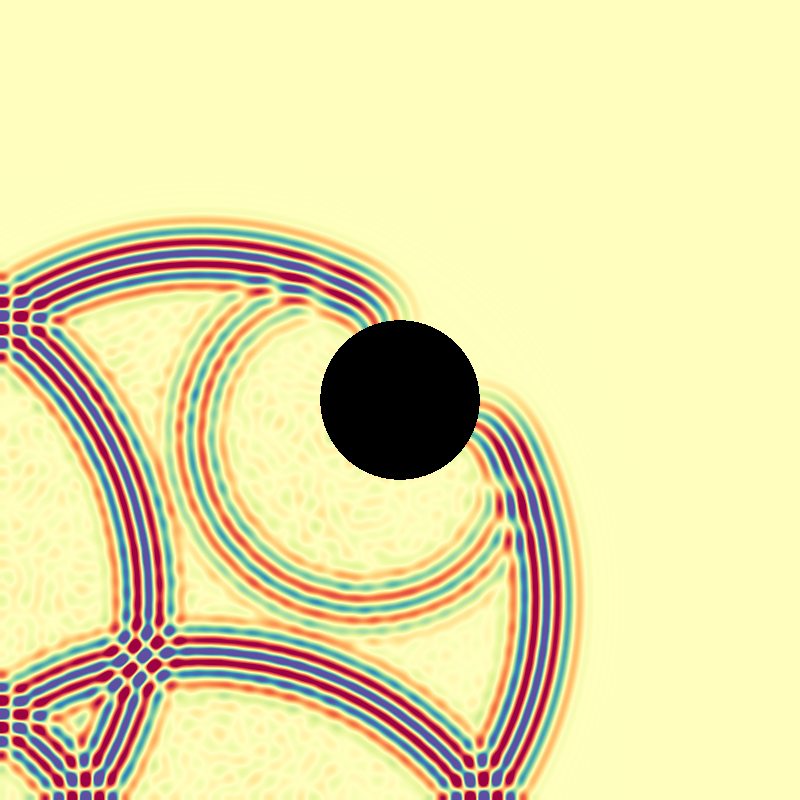
cuwave
Single-GPU differentiable higher-order finite difference wave propagation code.
Install it with pip install cuwave
We are the computational mechanics group at the Chair of Data Science in Civil Engineering, Bauhaus-Universität Weimar. We build numerical methods — and the code that runs them — for simulating and designing engineering structures.
Restores usable explicit time steps on badly cut cells by stabilizing the governing eigenvalues.
Derives the critical time step that explicit time integration must respect on immersed meshes.
Compares explicit and semi-explicit immersed schemes for transient wave problems.
Represents localized failure through a strain discontinuity instead of a smeared damage band.
Treats only the small cut cells implicitly, keeping the bulk of the mesh explicit and cheap.
Carries ductile damage through to crack closure and contact within a single formulation.
The data structures and algorithms behind multi-level hp-refinement in any dimension.
Predicts which damage mode wins as tunnel cracks and delamination compete in laminates.
A cheap model for how cracking degrades laminate stiffness, without resolving every crack.
A tailored 2D element that captures three-dimensional off-axis tunnel cracks.
Quantifies how fiber arrangement at the microscale changes crack driving forces.
Removes the memory wall of transient adjoints, putting billion-parameter designs on one GPU.
Reconstructs geometry at several resolutions by combining splines with the finite cell method.
Compares ways of parametrizing an unknown boundary when inverting wave measurements.
Designs the beam profile itself so that the melt pool follows a prescribed temperature field.
Measures how well thermal simulations match thermography, using statistical similarity tests.
Asks how much of the printed outcome a purely thermal model can actually predict.
Tests thermal models against bead-on-plate experiments across a range of beam shapes.
Optimizes the laser intensity distribution to improve melt pool geometry.
Resolves the moving heat source by refining in space and time at once.
Examines what time integration accuracy is needed for reliable process temperatures.
Replaces the return-mapping step of plasticity with small, reliable learned surrogates.
Learns on the mesh graph to invert wave measurements for unknown material fields.
Reuses networks trained on earlier reconstructions to shorten new inversions.
A methodological survey of where deep learning has, and has not, proven useful in mechanics.
Flags anomalous prints and tracks properties from process data using a GAN.
Uses a neural reparametrization of the design field to escape poor local optima.
Discovers neural reparametrizations for regularization in inverse problems.
Single-GPU differentiable higher-order finite difference wave propagation code.
Install it with pip install cuwave
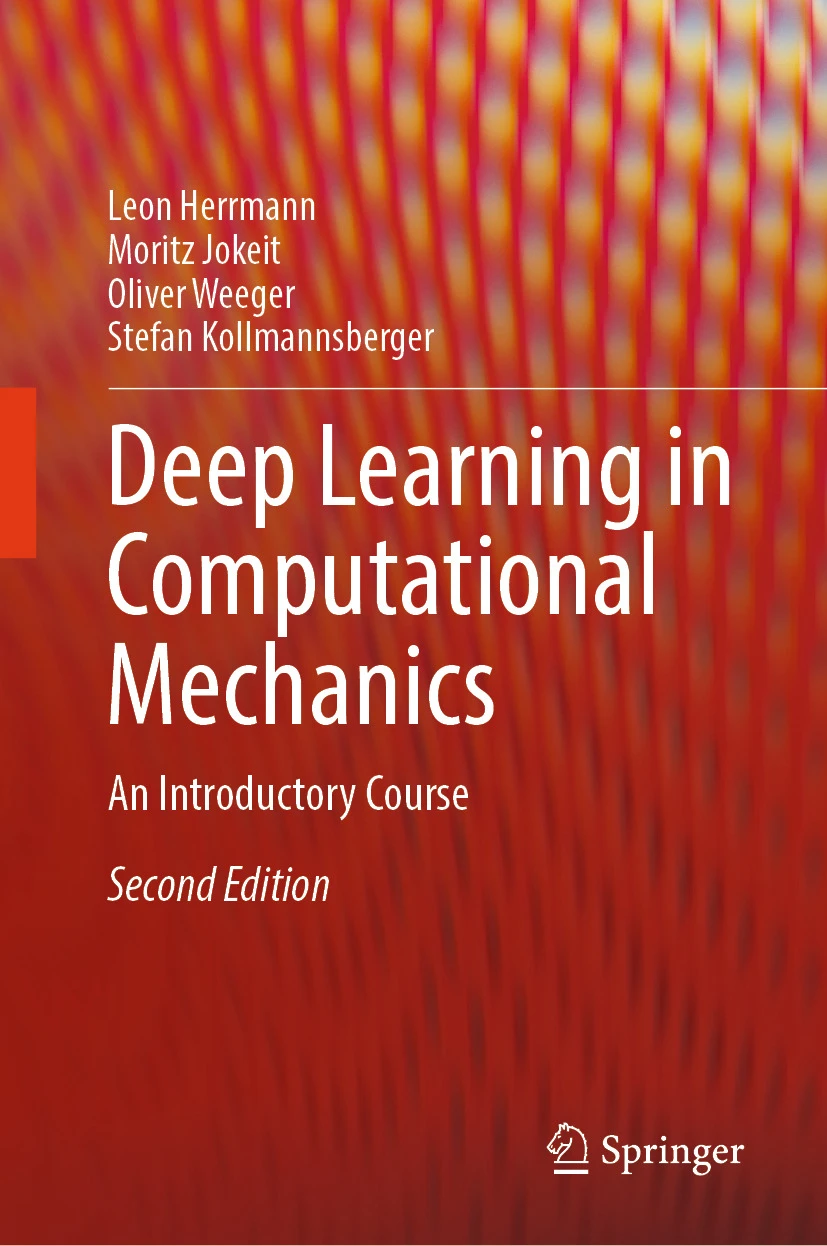
Exercises and reference implementations accompanying our introductory course and textbook on deep learning for mechanics.
Efficient multi-level hp- and other finite element methods in arbitrary dimensions.
Install it with pip install mlhp
A collection of machine learning enhanced physics solvers and optimizers, answering when and where deep learning is useful in numerical simulation.
Convenient thermomechanical simulation of powder bed fusion additive manufacturing processes.
Install it with pip install pbf
The research areas above list some of our published journal articles. The complete list is maintained on the chair's publication page.